In the high-stakes world of today's serious oversteer competition, victory is no longer solely a result of brute horsepower or behind-the-wheel courage. Instead, it is now a intricate engineering challenge which demands a meticulous blend of choosing a proven car, arming it with the correct competition components, and, most essentially, grasping its dynamic characteristics on the course through cutting-edge vehicle dynamics analysis tools. This exhaustive handbook functions as your master plan starting from the initial idea of a competition vehicle right through to the final engineering-refined tweaks that transform a strong machine into a predictable champion. We will thoroughly explore the precise engineering of vehicle alignment optimization, showing how a state-of-the-art suspension tuning tool like precise measurement hardware removes assumptions and delivers exceptional visibility into your chassis's actual behavior.
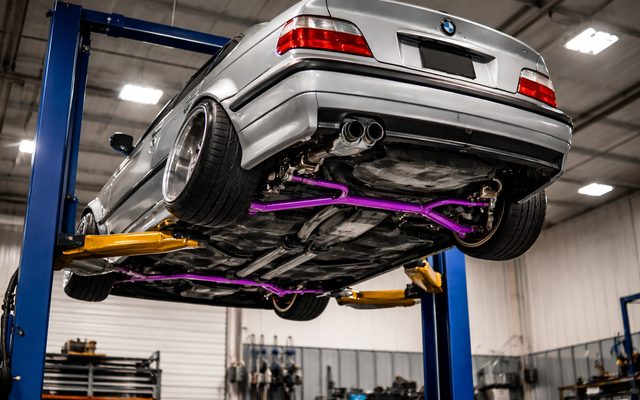
The bedrock of any successful drift car is, indisputably, the chassis itself. A select group of platforms have attained renowned reputation within the global drifting community due to their inherent weight distribution, durable design, and the immense range of aftermarket parts available. Picking the right car is the primary and most crucial choice a enthusiast will make. For instance, the BMW E36 is universally acknowledged as among the best all-around drift cars of all time. Its near-perfect 50/50 weight distribution, combined with a driven rear axle setup and extremely reliable six-cylinder motors, establishes a chassis that is simultaneously accessible for newcomers and extremely capable in the control of a pro pilot. The next step of this philosophy, the E46 model BMW, refines these qualities with a more refined structure, broader stance for greater stability, and still a greater degree of lock directly from the OEM. Another dominant contender in the professional circuit is the Corvette C6.
This muscle-derived sports car brings a unique set of advantages to the drifting discipline, featuring a lightweight aluminium structure, a rear-mounted transaxle that helps create an excellent balance, and the immense thrust of a powerful LS-series V8 engine. This fusion transforms it into an utter force on track, designed of initiating and holding long slides with seemingly effortless application of acceleration. For drivers seeking outstanding bang-for-the-buck, the 350Z model Nissan stands out as a top-tier example. It is delivered from the manufacturer with a stiff platform, a effective original LSD, and the responsive VQ35DE engine that offers sufficient performance for learning and advancing in the discipline. Its successor, the Nissan Z34, presents more improvements in structural rigidity, handling precision, and overall powerplant power, establishing its place as a favorite pick among professional competitors. Other legendary cars that merit mention are the nimble rotary-powered Mazda FC, the most popular Nissan S13, the torque-rich Ford Mustang SN95, the electronic-equipped BMW E90, and the small yet surprisingly engaging and instructive Mazda MX-5. Each of these chassis gives a distinct set of characteristics, challenges, and capabilities, but they all have in common the basic components necessary to become a competitive sliding vehicle.
However, selecting the right car is just the beginning. To access the full performance of any of these vehicles, major modifications to the steering system and suspension systems are completely non-negotiable. This is where the domain of precision drift-spec hardware becomes critical view. The single most impactful improvement for a serious competition vehicle is the installation of a high-performance drift angle kit. These advanced kits, such as those manufactured by specialist companies like specialist manufacturers, are created to dramatically increase the car's available steering angle. A factory road car is severely restricted in how far its tires can rotate, a design compromise for public road use. In sliding, but, maximum opposite lock is frequently required to control and sustain a angle. An steering kit replaces the OEM steering knuckles, rod ends, and sometimes control arms with pieces that allow the steered wheels to achieve angles in excess of 70 or even 80 °, as opposed to a average factory angle of around 40 to 50 degs.
This vastly greater lock provides the operator with dramatically more command during a drift, enabling it to be much easier to begin a slide, maintain it through a sweeping corner, and change smoothly from one side to another. The improvement in controllability is truly transformative. Combined with a correctly specified angle kit is the every bit as critical modification to the vehicle's damping system. Off-the-shelf or even premium street dampers are simply not engineered for the particular and brutal requirements of competitive oversteer. A dedicated pair of suspension units is paramount. These specific coilovers feature specific piston tuning and spring rates that are tuned for the rapid mass transition that is characteristic of drifting. When a operator initiates a drift, the car's weight is thrown rapidly to the outer of the turn. Optimal performance suspension manage this transfer in a predictable way, enabling the car to stabilize rapidly and providing the pilot precise feedback through the controls and cockpit. They additionally enable accurate setting of stance, damping stiffness, and corner weighting, which are all integral elements of fine-tuning the vehicle's dynamics to a specific venue or piloting technique. In combination, a top-tier drift angle kit and a expertly chosen system of drift-spec coilovers are the core mechanical base upon which all subsequent refinement is based.
Once the fundamental hardware is installed, the next essential step in the development is the precise tuning of the chassis's alignment. This is the realm of chassis dynamics adjustment, a methodology that can appear overwhelmingly complex to the beginner but is, in practice, the defining factor to converting a collection of fast pieces into a harmonious and consistent vehicle. The most debated element of suspension geometry for drifting is certainly camber angle. Camber is the angle of the tire in relation to the upright plane when viewed from the forward of the chassis. If the top edge of the wheel is tilted towards the chassis, this is referred to as negative camber. In oversteer driving, inward-leaning wheels on the steering wheels is widely employed and is regarded as necessary. The logic is deeply related to physics.
When a vehicle is turning at extreme angles, the frame rolls to the external of the corner. This lean makes the outer front tire to lose its best grip area with the tarmac. By introducing an inward tilt, the wheel is pre-tilted to compensate for this roll. As the chassis leans into the turn, the outside front tire becomes more upright with the asphalt, maximizing its traction at the critical moment when it is absolutely essential for steering authority. Commonly, front angles for a serious sliding vehicle range from approximately -3 degrees to as extreme as -5 degrees or even beyond, based on the specifics of the car setup, compound selection, and operator style. The rear axle tires also employ inward lean, but the values are typically more conservative and subtler than the front axle. Excessive negative camber at the rear can make the car extremely tail-happy and hard to control on power application, as it diminishes the available tire footprint of the driven tires during straight-line power delivery. Therefore, rear axle adjustments are commonly in the ballpark of -1 degree to -3 degrees, finding a careful compromise between giving adequate lateral traction to assist in starting and holding the slide while also maintaining good grip for exiting the turn. camber angle is merely one part of the larger alignment picture, which additionally includes toe setting, self-centering steering, and suspension-induced steering adjustment.
Toe angle refers to the orientation of the tires when viewed from above. Positive toe means the leading edges of the wheels are nearer together than the trailing edges, while outward toe means the reverse. For drifting, a small amount of front axle negative toe is often run to quicken the initial directional response, making the chassis feel more nimble and eager to begin a drift. Rear axle toe setting is generally set to zero or a extremely slight amount of inward toe to foster straight-line stability under acceleration. caster angle is the longitudinal or aft inclination of the steering axis when looked at from the lateral of the chassis. Positive caster increases feedback and high-speed stability, and it additionally increases inward lean gain during turning, which is extremely beneficial. Tuning these settings is a intricate interplay where a adjustment to one parameter can and often will affect the others. The old-school process for tuning a vehicle's suspension geometry for competition has for a long time been a tedious process of experimentation and feeling. A driver or engineering group would make a adjustment based on experience, test the car on track, rely on the operator's subjective perception and feedback, and then apply an additional adjustment. This loop would continue over and over until the vehicle felt "good" or the available practice session ran out. This methodology is not just extremely wasteful in terms of man-hours and tires, fuel, and parts, but it is also deeply flawed.
Pilot sensation is a famously inconsistent metric, colored by many variables such as tiredness, changing track surfaces, temperature, and merely the focus of the driver on that particular run. What feels "loose" on one lap might feel "understeery" on the next lap, resulting in contradictory information and ineffective adjustments. This age-old limitation in chassis setup is exactly where contemporary telemetry systems has intervened to revolutionize the methodology.
The development and adoption of specialized vehicle dynamics tools has brought about a radically different age for tuning and refining professional sliding vehicles. This new generation of systems, exemplified by groundbreaking systems like data acquisition tools, operate by directly measuring the live physical performance of the car as it is piloted on the course. In contrast to depending on personal impression, these devices collect measurable metrics on essential parameters such as damper compression and extension, wheel speed, acceleration forces, steering angle, and accelerator and brake pedal application. This raw telemetry is then interpreted by sophisticated algorithms that can plot and analyze the information in a clear format. For the very first time, tuners and teams can visualize specifically what the vehicle is performing at every millisecond of a drift. This ability transforms the whole alignment optimization process. Think about the aforementioned challenge of dialing in the front camber for a particular vehicle. As an alternative to introducing a change from -3 degrees to -3.5 degrees and then running several runs to try and "feel" a difference, a telemetry system can deliver immediate and definitive feedback. The vehicle dynamics tool software can indicate in a chart how the suspension's grip is acting during the key stages of a angle: initiation, holding the angle, and changing direction. It can demonstrate if the existing angle is permitting the loaded tire to keep optimal loading or if the tire is working inefficiently on its outer shoulder.
The system can subsequently make fact-based suggestions for change. Perhaps the telemetry indicates that the tire is still overworking its outer shoulder at -3.5 degrees of negative camber, implying that even more angle, say -4 degrees, might be warranted. On the other hand, the data might indicate that the tire is failing to reaching optimal operating temp or that the inner edge is degrading excessively, which could suggest that there is overly aggressive negative camber and a slight lessening back to -3.2 degrees would be better optimal. This standard of accuracy and practical insight was completely unimaginable in the time of solely mechanical adjustment.
The benefit of employing a advanced drift telemetry system goes far beyond just dialing in camber angles. It functions as an priceless coilover setup tips that is specific to your particular chassis. When fine-tuning the shock absorber clickers on your adjustable dampers, instead of relying on imprecise guidelines or mimicking another team's settings, you can use the telemetry to observe how the car is performing in response to your tweaks. The tool can show drift tuning app the wheel movement trace over a section of track, highlighting if the shocks are handling the body movement optimally or if they are allowing the chassis to bounce too much after a direction change. It can help in pinpointing problems like hitting the bump stops or excessive extension, enabling you to introduce educated choices to spring preload, rebound/compression values, or stance. This methodology translates equally to the detailed art of car alignment tuning. Beyond camber angle, the system can offer insight into how changes to toe and caster are affecting the car's handling during different parts of a drift. For example, it can allow you to ascertain the best amount of front axle negative toe for your individual angle kit geometry and driving technique by analyzing the response time of turn-in reaction and the stability of the car at full countersteer. This turns the software an exceptionally effective vehicle dynamics manual that is constantly informed by the live performance of your personal vehicle on the circuit. It moves the whole project from a dark art into a methodical engineering exercise.
Furthermore, the utility of a tool like modern telemetry is in no way limited to professional suspension engineering teams with large budgets. For the grassroots driver, it serves as an incredible equalizer. It practically provides the driver with the knowledge of a expert dynamics engineer without the corresponding cost. It drastically shortens the development time by providing clear answers to problems that would traditionally take years of experimentation to solve. A builder can learn how their individual car reacts to specific inputs, building a more profound comprehension of suspension theory in the process. It also opens up professional chassis dynamics principles, allowing all drivers with the drive to refine their car to accomplish it in a systematic and successful fashion. This is particularly significant in a sport like drifting, where engineering expertise has in the past been a highly secretive advantage among top teams. Today, that power can be in the toolkit of any motivated builder.
In the final analysis, the path to engineering and dialing in the ideal competitive sliding vehicle is a multi-stage project that smoothly integrates time-honored mechanical knowledge with 21st-century digital tools. It commences with the informed choice of a legendary platform, then built upon the integration of essential drift-spec parts like drift-spec drift angle kits and properly valved performance suspension units. The build then moves into the precision phase of car suspension tuning, where parameters like camber, toe setting, and caster are meticulously adjusted to complement the chassis's modified capabilities and the driver's personal needs. The final step, and what really separates the today's process from the old ways, is the adoption of a sophisticated drift telemetry software. This platform eradicates the uncertainty and waste of purely seat-of-the-pants setup by providing empirical, real-time data on how the chassis is truly behaving. It acts as an indispensable suspension tuning tool, a comprehensive drift suspension tuning guide, and a all-in-one vehicle dynamics tool. In unison, this holistic philosophy guarantees that every aspect of the drift car—from the pick of the chassis to the final tweak on the suspension—is optimized for peak performance on the circuit. It embodies the total evolution of the art of drifting, bridging physical driving skill with precise chassis dynamics to create the most effective vehicles imaginable.